
SLA vs Uptime vs Disaster Recovery: What 99.99% Actually Buys You
A 99.99% SLA allows 52 minutes of downtime a year and pays you back in partial credits on a future bill. Reliability comes from SLOs, dependency math and a restore you have actually run.
Key takeaways
- An SLA is a refund policy, not a reliability plan.
- A 99.99% SLA allows about 52 minutes of downtime a year, and missing it usually earns a 10% to 30% credit on a future bill.
- Real reliability comes from internal SLOs set tighter than the SLA, honest dependency math, and RTO and RPO targets proven by restore drills.
On this page
An SLA is a refund policy, not a reliability plan. A 99.99% SLA allows 52 minutes of downtime a year, and when the provider misses it you get a credit on a future bill, not your revenue back. What keeps you up is an internal SLO, honest dependency math, and a disaster recovery plan you have rehearsed.
Verified againstChecked against official docs
Amazon Compute SLA (last updated May 25, 2022), AWS's October 2025 us-east-1 post-event summary, the AWS disaster recovery whitepaper, the Google SRE book, Microsoft Learn's SLA guidance and Uptime Institute's 2026 outage analysis. Checked November 2026.
On October 19 and 20, 2025, AWS us-east-1 had a disruption that AWS's own summary dates from 11:48 PM to 2:20 PM PDT: about 14.5 hours. A 99.99% target allows 4 minutes and 19 seconds a month. Everything below follows from that gap.
The nines, in minutes you can actually feel
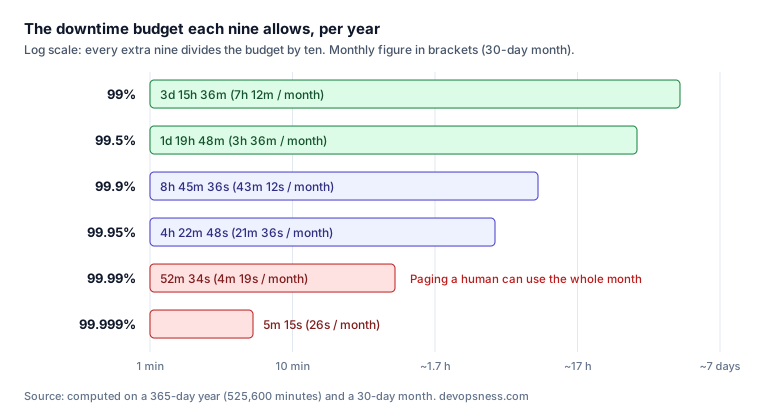
Each extra nine cuts your downtime budget by ten. The jump from three nines to four is the jump from "a bad deploy and a rollback" to "an alert, a human, and a fix inside five minutes, once a month at most".
| Availability | Downtime per year | Per 30-day month | Per week |
|---|---|---|---|
| 99% | 3d 15h 36m | 7h 12m | 1h 40m 48s |
| 99.5% | 1d 19h 48m | 3h 36m | 50m 24s |
| 99.9% | 8h 45m 36s | 43m 12s | 10m 5s |
| 99.95% | 4h 22m 48s | 21m 36s | 5m 2s |
| 99.99% | 52m 34s | 4m 19s | 1m 0s |
| 99.999% | 5m 15s | 26s | 6s |
Computed on a 365-day year. Two consequences most teams skip. First, at four nines your paging path alone (alert evaluation, notification, a human acknowledging) can eat the month's budget before anyone types a command, so four nines means automated failover, not faster humans. Second, five nines is 26 seconds a month: one slow DNS change, one certificate expiry, one connection-pool restart.
An SLA is a refund policy, not a reliability plan
Read the Amazon EC2 SLA and the gap is in the fine print, not the headline. The region-level commitment is 99.99% monthly uptime, and it only applies if your running instances sit in two or more Availability Zones. Below 99.99% you get a 10% service credit, below 99.0% 30%, and below 95.0% 100%, calculated on that month's EC2 bill for the affected region.
Three conditions make the payout smaller than it sounds:
- "Unavailable" is narrow. It means all your running instances across those AZs concurrently have no external connectivity. Elevated API error rates and failed launches, the bulk of EC2's impact on October 20, are not in that definition.
- You have to claim it. The request must reach AWS by the end of the second billing cycle after the incident, and credits normally apply against future EC2 payments. They "will not entitle you to any refund or other payment from AWS".
- The ceiling is your EC2 bill. Not your lost orders, your support load, or your own customers' SLA credits.
Run the math on that outage. EC2 impact ran from 11:48 PM to 1:50 PM, about 842 minutes. Against a 31-day October that is 98.11% uptime, the 30% tier, if every minute counted. Most did not. The root cause, per AWS, was a latent race condition in DynamoDB's DNS automation that left an empty DNS record for the regional endpoint, and it cascaded into EC2 and Network Load Balancer.
The vendor's SLA is useful for one thing: knowing what the vendor is not promising. Your customers do not care which provider broke.
SLA, SLO, SLI, error budget: four words, one chain
The Google SRE book gives the cleanest test: "what happens if the SLOs aren't met?" If the answer is money or contract terms, it is an SLA. If nothing happens outside your team, it is an SLO.
- SLI is the measurement: the share of requests that succeeded in under 300 ms, measured at the load balancer.
- SLO is your internal target for that SLI: 99.95% over 28 days.
- SLA is the contract you sign with customers, with consequences: 99.9% monthly, or credits.
- Error budget is 100% minus the SLO. At 99.95% over 28 days, that is about 20 minutes to spend on deploys, experiments and bad luck.
Set the SLO tighter than the SLA, as the SRE book recommends, so you see trouble before your customers' lawyers do. Then page on how fast you spend the budget, not on CPU graphs; burn-rate alerting on SLOs covers the Prometheus rules.
Composite availability: your dependencies multiply
Your uptime is not your provider's SLA. A request that needs your app, a managed database and a third-party API in series is available only when all three are. Multiply:
python3 -c "import math; p=math.prod([0.9999, 0.9995, 0.999]); print(f'{p:.4%}', round((1-p)*525600), 'min/yr')"
99.8401% 841 min/yr
Three respectable components produce 99.84%, about 14 hours a year. That is the October outage again, as a yearly budget. Redundancy goes the other way: two independent 99.9% replicas behind a health-checked failover give 1 − (0.001 × 0.001), or 99.9999%, on paper.
The words "on paper" carry the weight. Microsoft's own SLA guidance tells you not to multiply SLA percentages to estimate availability, because the product is at best a ceiling and "assumes that all services fail independently, which rarely happens". Two replicas in one region share its DNS, its control plane and its bad deploy. In July 2024, one faulty CrowdStrike content update affected an estimated 8.5 million Windows devices, by Microsoft's count, across companies that had never heard of each other's architectures. Correlated failure is the normal case.
Use the multiplication to find your weakest serial link and to set a realistic SLA. Do not use it to sell five nines.
Downtime math the business understands
Engineers argue about nines; finance asks what an hour costs. Uptime Institute's 2026 outage analysis has the current numbers: 57% of respondents say their most recent major outage cost more than $100,000, and for the second year in a row, one in five say their most recent impactful outage cost more than $1 million. Power is still the leading cause of impactful outages, and while outage frequency per site has fallen for five years, the improvement is slowing.
Turn your own cost per hour into a decision. A typical case: a checkout service that books $40,000 an hour at peak. Moving from 99.9% to 99.95% saves about 4.4 hours a year, roughly $175,000 of exposure at peak rates. If the second region, the failover testing and the on-call time cost more than that, three nines is the right business answer, and saying so out loud is part of the job.
Count planned downtime too. Maintenance windows excluded from an SLA still look like an outage to the user who hits them.
RTO and RPO: disaster recovery is two numbers and a drill
Uptime covers the bad hour. Disaster recovery covers the bad week: a lost region, a deleted database, ransomware. AWS's DR whitepaper defines the two numbers that matter. RTO is the maximum acceptable delay between the interruption and restoring service. RPO is the maximum acceptable time since the last data recovery point, which is to say, how much data you can lose.
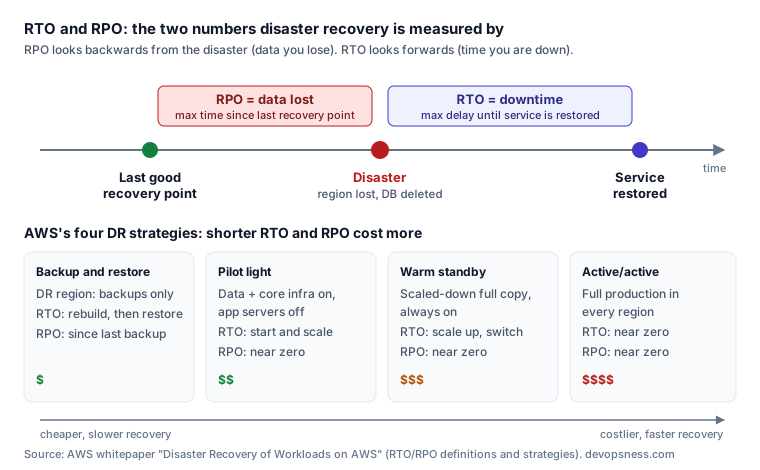
The whitepaper's four strategies are a price list for those numbers:
| Strategy | Running in the DR region | RTO | RPO | Cost |
|---|---|---|---|---|
| Backup and restore | Backups only | Slowest: rebuild then restore | Since last backup | Lowest |
| Pilot light | Data and core infra on, app servers off | Start and scale compute | Near zero with continuous replication | Low |
| Warm standby | Scaled-down full copy | Scale up and switch | Near zero | Medium |
| Multi-site active/active | Full production | Near zero for most disasters | Near zero | Highest, most complex |
The strategy is the cheap part. The failure is untested restores. GitLab's January 2017 postmortem is the classic: an accidental deletion on the primary database, replication already broken, and pg_dump backups that "failed silently" because the tool was PostgreSQL 9.2 against a 9.6 server. Recovery took over 18 hours and lost data for at least 5,000 projects. Several backup methods were in place. Nobody owned testing them, so nobody knew they were broken.
If your RPO is an hour, restore last night's backup into a scratch environment every month and time it; restore testing in practice has the checklist. If your RTO is minutes, you need standby capacity, and active-active vs active-passive is the next decision.
Questions people ask
How much downtime is 99.9% uptime?
99.9% allows 8 hours, 45 minutes and 36 seconds of downtime a year, or 43 minutes and 12 seconds in a 30-day month and about 10 minutes a week. That is enough for a slow incident or two a month, which is why three nines is a sensible SLA for most internal services and many SaaS products.
What is the difference between an SLA and an SLO?
An SLO is an internal reliability target measured by an SLI, such as 99.95% of requests succeeding. An SLA is a contract with customers that attaches consequences, usually service credits, to missing a target. Set the SLO tighter than the SLA so you react before the contract is breached.
What is a good RTO and RPO?
There is no universal number; derive them from cost. Start from what an hour of downtime and an hour of lost data cost the business, then pick the cheapest DR strategy that meets both. A common starting point is an RPO of minutes via continuous replication and an RTO of one to four hours with a pilot light.
Do cloud SLA credits cover my losses?
No. AWS credits are a percentage of the affected service's monthly bill, normally apply against future payments, must be claimed by the end of the second billing cycle after the incident, and are your sole and exclusive remedy, so lost revenue is not covered. Treat them as a signal of the provider's commitment, never as insurance.
The decision, concretely
- Signing a customer SLA? Promise one nine less than your SLO and exclude what you cannot control in writing. A 99.95% SLO supports a 99.9% SLA.
- Choosing a target? Price an hour of downtime first. Four nines only pays where an hour costs more than the second region and the automation to use it.
- Calculating availability? Multiply serial dependencies to find the weakest link, then assume correlated failure inside one region anyway.
- Writing a DR plan? Write down RTO and RPO per service, pick the cheapest strategy that meets both, and schedule a timed restore drill. An untested backup is a hope, not a plan.
The call we'd make
Default to a 99.9% customer SLA backed by a 99.95% internal SLO, burn-rate alerts, and a backup-and-restore or pilot-light DR plan with a monthly timed restore. Go to four nines and active-active only for the handful of services where you can show the cost of an hour, because the vendor credit will not cover the gap.
Sources
- Amazon Compute Service Level Agreement
- Summary of the Amazon DynamoDB Service Disruption in us-east-1, October 2025
- Business continuity plan and recovery objectives, AWS whitepaper
- Disaster recovery options in the cloud, AWS whitepaper
- Service Level Objectives, Google SRE book
- How to read a service-level agreement, Microsoft Learn
- Annual outage analysis 2026, Uptime Institute
- Postmortem of database outage of January 31, GitLab
Cite this article
Kiril Urbonas (2026). SLA vs Uptime vs Disaster Recovery: What 99.99% Actually Buys You. DevOpsNess. https://www.devopsness.com/blog/sla-uptime-downtime-disaster-recovery
[SLA vs Uptime vs Disaster Recovery: What 99.99% Actually Buys You](https://www.devopsness.com/blog/sla-uptime-downtime-disaster-recovery) (Kiril Urbonas, DevOpsNess, 2026-11-22)
More from DevOps
Explore more articles in this category

Zero Trust Architecture in Multi-Cloud
We removed the corporate VPN, set up workload identity everywhere, and made every service prove who it is on every call. The actual implementation, with what worked and what we abandoned.

Argo Rollouts: Canary Analysis That Auto-Aborts on Bad Metrics
A bad deploy used to mean a pager at 2am and a manual rollback. Now Argo Rollouts watches the error rate and aborts the canary itself before anyone wakes up.

Fixing Docker Build Cache: Slow Builds and Stale Layers
Two failures wear the same face: builds that rebuild everything every time, and builds that hand you a stale image. Both trace back to how layer caching keys work.
You might have missed
Evergreen posts worth revisiting.


