OpenRouter Pulls ZDR From 125 Endpoints After Prompt Leaks (Nov 22): Lock Your Routing
Canary prompts showed breached providers, logging resellers and ignored privacy flags. OpenRouter off-boarded three providers and cut 125 endpoints from Zero Data Retention. Here is how to check what your gateway actually routes to.
Key takeaways
- On November 22, 2026 OpenRouter off-boarded three inference providers and removed 125 endpoints from Zero Data Retention after Dragos canary tests showed leaked prompts.
- Teams routing through OpenRouter should enforce ZDR at account level, pin providers with only and allow_fallbacks false, and rotate any secret that went into a prompt.
On this page
On November 22, 2026 OpenRouter off-boarded three inference providers and removed 125 endpoints from Zero Data Retention eligibility after Dragos showed prompts leaking from providers behind it. If your apps call OpenRouter, enforce ZDR at the account level, pin the providers you trust, disable fallbacks, and rotate any credential that ever went into a prompt.
Verified againstChecked against official docs
OpenRouter's November 22, 2026 announcement, the Dragos canary research, the Phala, Together, Novita and Atlas Cloud incident notices, and OpenRouter's ZDR and provider selection docs and public endpoints API. Checked November 23, 2026.
What happened, in dates
Dragos chief research officer HD Moore published the research on November 19. Between July and November 2026 his team sent about two million prompts seeded with unique URLs, DNS names and real AWS keys tied to empty accounts, then watched which ones got used. Three findings: attackers inside three hosting providers copying requests (some marked ZDR), marketplace resellers reading customer prompts through ordinary request logging, and providers ignoring privacy settings, including a Chinese AI lab fetching URLs from roughly two-thirds of the "no data collection" or ZDR requests sent to its models.
OpenRouter's post followed on November 22. It says the findings showed no breach of OpenRouter itself, lists the three actions (off-board three providers, remove 125 endpoints from ZDR, notify affected customers), and says removed endpoints need "appropriate assurances and validation" before ZDR comes back. It does not name the three off-boarded providers. Four provider notices are linked from it:
| Provider | What their notice says | Window |
|---|---|---|
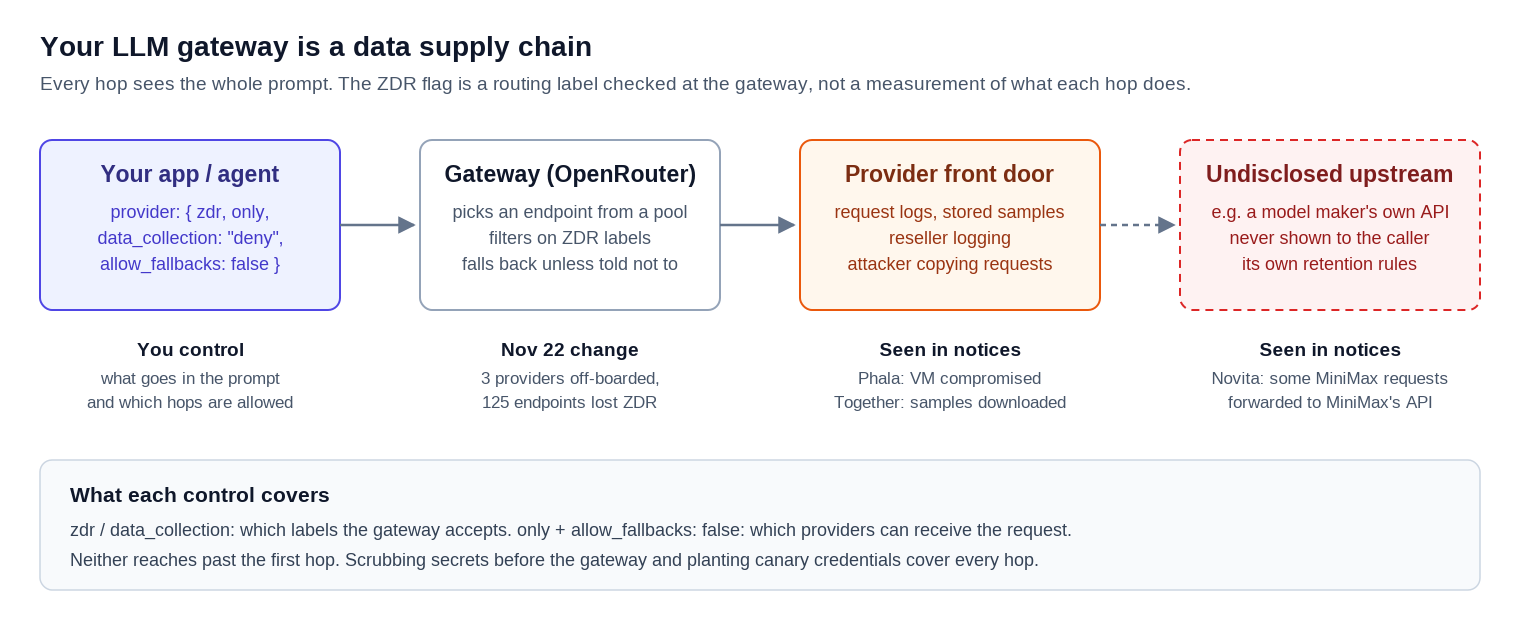
| Phala | Attacker controlled the inference VM for DeepSeek V4 Flash 0731 traffic routed from OpenRouter; treat request contents as exposed | Oct 21, 00:00 UTC to Nov 8, 05:35 UTC |
| Together | Stored prompt samples (MiniMax M3, GLM-5.2, Kimi K2.6) were downloaded after an AI coding agent committed a Hugging Face credential to a public repo | Mainly June 24, July 4, 8 and 14 |
| Novita | A routing configuration issue forwarded some MiniMax requests to MiniMax's official API, including requests from OpenRouter | May 28 to Nov 11 |
| Atlas Cloud | Dragos saw a third party open links from prompts sent to MiniMax's official API; Atlas pulled its models from OpenRouter by choice | Q3 and early Q4 |
Am I affected?
Three questions: did you route through OpenRouter, did you leave provider choice to the router, and did anything secret go into a prompt. OpenRouter says it notified all potentially affected customers, so check the account owner's inbox first. Then check your code and the live endpoint pool:
# 1. Where does your code call OpenRouter, and does it set any routing policy?
grep -rnE 'openrouter\.ai|data_collection|allow_fallbacks|"zdr"|"only"' \
    --include='*.py' --include='*.ts' --include='*.js' --include='*.yaml' --include='*.json' .

# 2. Which providers are in the ZDR pool right now (public, no key needed)
curl -s https://openrouter.ai/api/v1/endpoints/zdr \
    | jq -r '.data[].provider_name' | sort | uniq -c | sort -rn

# 3. For one model you use, list the endpoints that are NOT ZDR-eligible
MODEL=deepseek/deepseek-v4-flash-0731
comm -23 \
    <(curl -s "https://openrouter.ai/api/v1/models/$MODEL/endpoints" | jq -r '.data.endpoints[].tag' | sort) \
    <(curl -s https://openrouter.ai/api/v1/endpoints/zdr | jq -r --arg m "$MODEL" '.data[] | select(.model_id==$m) | .tag' | sort)

# 4. How many models your own key can reach under your privacy settings
curl -s https://openrouter.ai/api/v1/models/user \
    -H "Authorization: Bearer $OPENROUTER_API_KEY" | jq '.data | length'
Run on November 23, check 3 returned 7 of 26 DeepSeek V4 Flash 0731 endpoints outside the ZDR pool, including novita/fp8, and no Phala endpoint at all. If check 1 finds calls with no provider block, every request was eligible for any endpoint OpenRouter's default routing picked, ZDR or not, unless the account privacy settings said otherwise. If you used MiniMax models through Novita or DeepSeek V4 Flash 0731 through Phala in those windows, search your own request logs for prompts that carried keys, tokens or private URLs, and rotate them.
What to change now
Set the floor at the account, then make each request explicit. In privacy settings, turn on ZDR for every model group (Anthropic, OpenAI, Google, SpaceXSI, all other models) and pick ZDR only if Safety Retention is not acceptable to you; self-serve accounts that never chose default to allowing it. On guardrails the fields are enforce_zdr_anthropic, enforce_zdr_openai, enforce_zdr_google, enforce_zdr_xai and enforce_zdr_other; the old enforce_zdr is deprecated.
Per request, the provider object is where you stop the router from choosing for you:
{
  "model": "deepseek/deepseek-v4-flash-0731",
  "messages": [{"role": "user", "content": "..."}],
  "provider": {
    "zdr": true,
    "data_collection": "deny",
    "only": ["deepinfra", "together"],
    "allow_fallbacks": false
  }
}
zdr: true is an OR with your account and guardrail settings, so it can only tighten. data_collection: "deny" excludes providers that may store data. only is an allowlist of provider slugs; order sets the try order, and OpenRouter's docs say you also need allow_fallbacks: false if you do not want it to move on to other public providers. The slugs above are examples: pick providers from check 2 whose own terms you have read. Expect more failed requests from a narrow pool, and handle them with retries in your code rather than reopening fallbacks.
Two cheaper controls do not depend on any vendor. Scrub secrets before the gateway, since an agent forwards whatever it can read. And seed your own canary, as Dragos recommends: a fake credential in the context each agent and pipeline sends, with any use treated as an incident. If you run an internal gateway such as LiteLLM, the same rule applies in its config: our AI gateway comparison covers which ones let you pin providers per route.
Where this breaks
ZDR on OpenRouter is a classification of each endpoint's policy, built from what providers state and from OpenRouter's agreements with them. Dragos showed the gap between that label and reality: in two of the three breaches, some of the stolen requests were marked ZDR. Its line that sums it up: "a privacy flag only binds the first hop."
- BYOK declarations are self-attested. OpenRouter's BYOK docs say a key marked "My account has ZDR" is treated as ZDR and "OpenRouter does not check it." Private endpoint declarations work the same way.
- Implicit caching counts as not retaining. OpenRouter's docs say in-memory prompt caching is not retention, so caching endpoints stay in the ZDR pool. As of November 23, 569 of the 929 endpoints in the API's ZDR list (Safety Retention included) support implicit caching. If your policy forbids any prompt persistence, that stance may not match it.
- Tools sit outside ZDR. Plugins and server tools such as web search follow their own backends' policies.
- There is a documented exception. OpenRouter announced on October 27 that it will screen all requests, ZDR included, for CSAM, with flagged content possibly retained for review.
- Still unknown as of November 23: the names of the three off-boarded providers, which 125 endpoints lost ZDR, and Phala's full root cause analysis.
None of this is unique to OpenRouter. Every multi-provider gateway, managed or self-hosted, adds hops you have to trust; the routing and fallback patterns for multi-provider gateways all assume the provider pool is honest.
Questions people ask
Which providers did OpenRouter remove?
OpenRouter's November 22 post says it off-boarded three providers but does not name them. It links incident notices from Atlas Cloud, Novita, Phala and Together, and notes that not every affected provider has posted publicly. Atlas Cloud says it withdrew its models from OpenRouter on its own decision. Treat any list of the three that circulates without a primary source as unconfirmed.
Does provider.zdr true guarantee my prompts are not stored?
No. It restricts routing to endpoints OpenRouter classifies as ZDR, plus Safety Retention endpoints unless your settings say ZDR only. The classification rests on provider policies and agreements, and the Dragos research found ZDR-marked requests copied during breaches. It reduces exposure to providers that openly retain data; it cannot stop an attacker already inside a provider.
Do I need to rotate keys?
Rotate any secret that appeared in a prompt sent to the affected routes: MiniMax models via Novita from May 28 to November 11, and DeepSeek V4 Flash 0731 via Phala from October 21 to November 8. Phala and Novita both advise rotation. Check agent traffic first: Dragos warns that AI agents will send whatever they can read, credentials included.
The call we'd make
Turn on account-level ZDR for all model groups today, add an explicit provider block with zdr, data_collection: "deny", only and allow_fallbacks: false to every production call, and plant a canary credential in each pipeline. The caveat: all of it narrows who sees your prompts, none of it proves what they do with them. For prompts that would hurt if they leaked, go direct to one first-tier provider under a contract, or host the model yourself.
Sources
- OpenRouter: Data Processing Incidents on Inference Providers (November 22, 2026)
- Dragos: Three breaches, endless leaks: Your AI supply chain needs canaries (November 19, 2026)
- OpenRouter Docs: Zero Data Retention
- Phala: November preliminary incident report
- Together AI: Security event: Prompt leakage for requests in June and July of 2026
- Novita: Privacy notice regarding MiniMax requests on Novita
- Atlas Cloud: Security notice on MiniMax's official API
Cite this article
Kiril Urbonas (2026). OpenRouter Pulls ZDR From 125 Endpoints After Prompt Leaks (Nov 22): Lock Your Routing. DevOpsNess. https://www.devopsness.com/blog/openrouter-zdr-125-endpoints-removed-november-22-prompt-leaks
[OpenRouter Pulls ZDR From 125 Endpoints After Prompt Leaks (Nov 22): Lock Your Routing](https://www.devopsness.com/blog/openrouter-zdr-125-endpoints-removed-november-22-prompt-leaks) (Kiril Urbonas, DevOpsNess, 2026-11-23)
More from AI
Explore more articles in this category

AI Agents in DevOps: From Copilots to Autonomous Automation in 2025
Copilots suggest, agents act. Here's the spectrum between them, where each earns its keep in DevOps, and how to add autonomy without lighting your infra on fire.

Debugging RAG Retrieval: Why It Returns Garbage
When RAG answers go sideways, the model usually isn't the problem. Here's a top-to-bottom checklist to find where retrieval actually breaks.

GitHub Copilot Alternatives Worth Trying in 2026
A practitioner roundup of the strongest GitHub Copilot alternatives in 2026, sorted by category, cost, privacy, and how they actually fit real workflows.
You might have missed
Evergreen posts worth revisiting.