Backblaze's December 1 Privacy Policy: What It Sells, What It Doesn't, How to Opt Out
Backblaze's new privacy notice, effective December 1, 2026, marks identifiers, browsing activity, purchase history and geolocation as sold or shared for targeted ads. It is about tracking and account data, not the files in your buckets. How to opt out, and how to check your B2 encryption either way.
Key takeaways
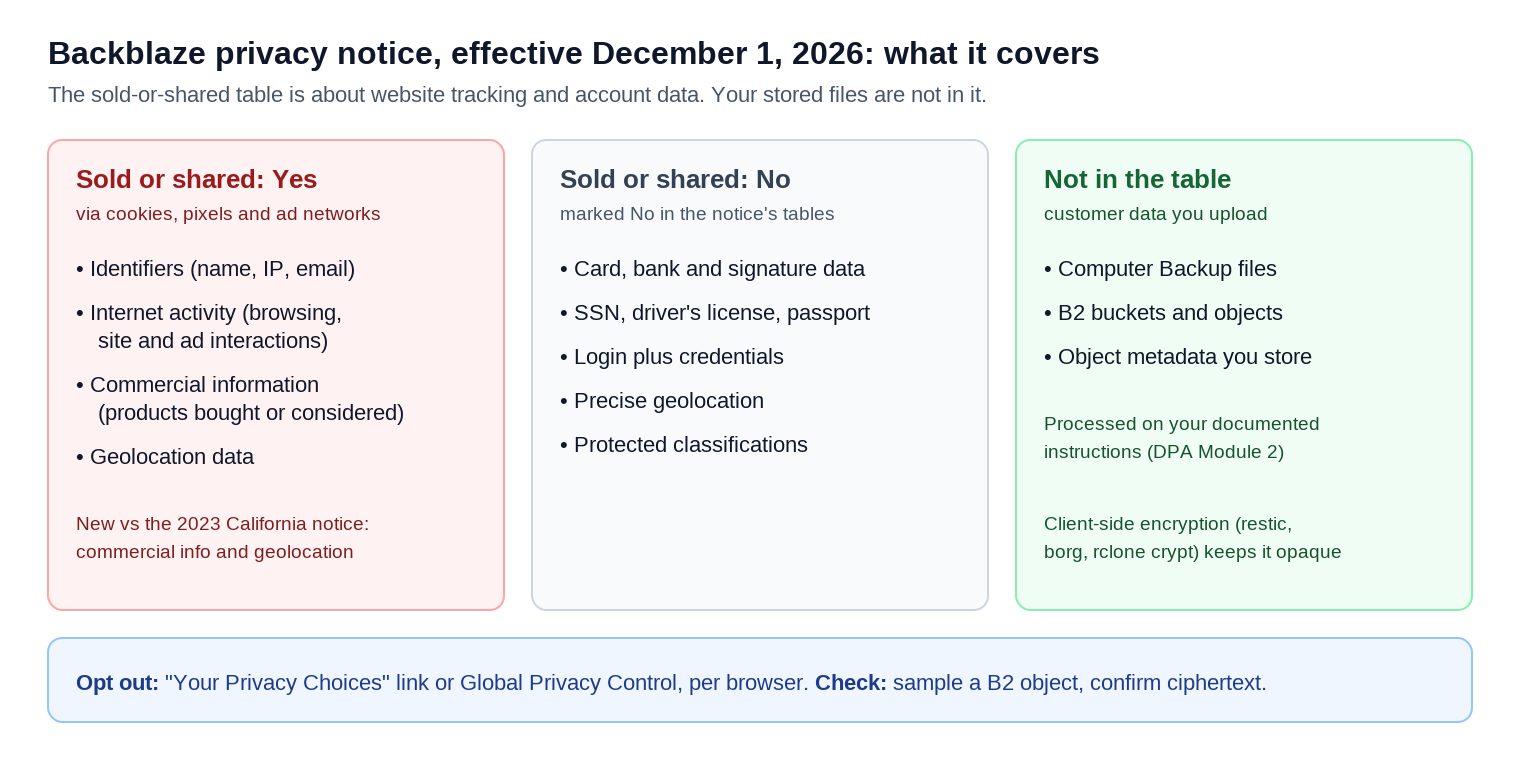
- Backblaze's privacy notice effective December 1, 2026 says identifiers, commercial information, browsing activity and geolocation data are sold or shared for targeted advertising, through website tracking technologies.
- It does not say stored files are sold.
- Opt out with the Your Privacy Choices footer link or Global Privacy Control, and encrypt B2 uploads client-side.
On this page
Backblaze's new privacy notice, effective December 1, 2026, lists identifiers, commercial information, browsing activity and geolocation data as sold or shared for targeted advertising. The mechanism it names is website tracking, not your backups. Opt out through the Your Privacy Choices link or Global Privacy Control, and make sure your B2 data is encrypted client-side anyway.
Verified againstChecked against official docs
Backblaze Notice at Collection and Privacy Policy (effective December 1, 2026), the April 30, 2026 Privacy Notice, the California residents notice (effective January 1, 2023), DPA Module 2, B2 server-side encryption docs, b2 CLI 5.0.3 help and changelog, and the B2, R2 and Wasabi pricing pages. Checked November 23, 2026.
What changed, in dates
Until late October 2026, backblaze.com/company/policy/privacy served the "Backblaze Privacy Notice, last updated April 30, 2026". That version (still online as privacy-april-2026) has no sale or targeted-advertising table. It covers cookies and vendors, and states that for files uploaded to Computer Backup and B2, Backblaze is the processor and the account owner is the controller.
The Wayback Machine shows the replacement, "Notice at Collection and Privacy Policy", at that URL by November 7 with "Last Revised On: October 29, 2026". By November 15 the header read "Effective Date: December 1, 2026". It hit Hacker News on November 21, with a second thread on November 22.
The new notice is organization-wide, with sections per US state, EEA/UK, Canada and Brazil. Its notice-at-collection table answers "Sold or Shared for Targeted Advertising" like this:
| Category (Backblaze's examples) | Old California notice (Jan 2023) | New notice (Dec 1, 2026) |
|---|---|---|
| Identifiers (name, address, IP, email) | Yes | Yes |
| Internet activity (browsing, search, site and ad interactions) | Yes | Yes |
| Commercial information (products bought or considered) | Not collected | Yes |
| Geolocation data (device location) | No | Yes |
| Cal. Civ. Code 1798.80(e) (signature, card and bank numbers) | No | No |
| Sensitive data (SSN, card plus credentials, precise geolocation) | No | No |
The jump is smaller than the headlines suggest, but real. California residents were already told in 2023 that identifiers and browsing activity went to "Social Networks, Advertising Networks". The new notice adds commercial information and geolocation, names advertising networks and analytics providers as recipients for the preceding 12 months, and puts the disclosure in the main policy every customer sees. An older undated Backblaze page, company/policy/privacy2, still says Backblaze "does not sell your information or share it with third-party advertisers", which explains much of the anger.
What it does and does not touch
The notice is specific about the mechanism: "Our use of tracking technologies may be considered a 'sale' or 'sharing' of personal information." Under CCPA and similar state laws, letting an ad network's cookie or pixel collect your IP and page views counts as a sale or share, even if no list changes hands. The cookie section says the same in plainer terms: partner cookies can follow you across other websites to target ads.
Nothing in the notice says the contents of your backups or B2 objects are sold or shared. It scopes itself to data Backblaze handles as a controller, unless a separate agreement says otherwise, and Backblaze's DPA Module 2 says it processes customer personal data "only in accordance with documented instructions" from the customer. The gap: the new notice drops the April version's explicit sentence that Backblaze is only the processor for uploaded files. Commercial information is also more than page views: Backblaze's own example is products or services purchased or considered.
Am I affected?
If you visited backblaze.com in the past year with third-party cookies allowed, likely, for the tracking categories. Check your opt-out status and your encryption posture:
# 1. In the browser you use for backblaze.com, open DevTools > Console:
#    navigator.globalPrivacyControl
#    true means the browser sends GPC, which Backblaze says it honors
# 2. Default server-side encryption per bucket (b2 CLI 4 or 5, jq installed)
b2 bucket list --json | jq -r '.[] | [.bucketName, (.defaultServerSideEncryption.mode // "unknown")] | @tsv'
# "unknown" usually means the key lacks readBucketEncryption; create a new key
# 3. Spot-check that stored objects are ciphertext, not readable files
b2 file cat b2://my-backups/data/00/<object-name> | head -c 4096 | file -
# restic or rclone crypt output should report "data", never "PDF" or "text"
What to do now
Opt out of the tracking. Click "Your Privacy Choices" in the backblaze.com footer and switch off targeted advertising cookies, or turn on Global Privacy Control in a browser or extension that supports it. Backblaze says it treats GPC as a valid opt-out, but if you are not logged in the opt-out is tied to that browser only, so repeat it per device. Requests to know or delete go through preferences.backblaze.com or privacyrequest@backblaze.com.
Encrypt on the client. restic encrypts every repository with your password by default, borg requires an encryption mode such as repokey at borg init, and rclone encrypts when you wrap the B2 remote in a crypt remote. None of them can encrypt objects already in a bucket, so start before the next upload.
Confirm SSE-B2 as a floor. The b2 CLI 4.8.0 changelog (September 14, 2026) says B2 now applies SSE-B2 as every bucket's default and rejects none. Per Backblaze's server-side encryption docs, SSE-B2 is AES-256 with no extra encryption charge, but a bucket default only covers files uploaded after it is set:
# Set default SSE-B2 explicitly (existing files stay as they are)
b2 bucket update --default-server-side-encryption=SSE-B2 my-backups
b2 bucket get my-backups | jq '.defaultServerSideEncryption'
SSE-B2 protects disks, not you from Backblaze: Backblaze holds the keys. SSE-C uses a key you supply per request, and client-side encryption keeps keys off Backblaze entirely.
Where this breaks, and the exit math
The opt-out covers browser tracking. It does not cover identifiers or purchase history Backblaze may disclose for other listed purposes, and the notice does not name the ad partners.
If you leave, egress is not the trap. As of November 23, 2026, B2 includes free egress up to 3x your average monthly storage, then $0.01 per GB, so a single full download of every byte fits inside the allowance. Keep the data in place until the copy finishes: the average is computed over the billing cycle, and deleting early shrinks it. Monthly storage for 10 TB after the move, as of November 23, 2026:
| Provider | List price | 10 TB per month | Egress |
|---|---|---|---|
| Backblaze B2 | $6.95/TB per 30 days | $69.50 | Free to 3x storage, then $0.01/GB |
| Cloudflare R2 Standard | $0.015/GB | about $150 | Free |
| Wasabi pay as you go | $7.99/TB | $79.90 | No egress fees, 90-day minimum storage |
R2 also bills writes at $4.50 per million, which adds up for repositories with many small objects. For the wider picture, read our cloud egress cost breakdown, and for R2 specifically, R2 vs S3 in practice. Whatever you choose, test a restore from the new bucket before deleting the old one.
As of November 23, 2026, we found no response from Backblaze staff in either Hacker News thread.
Questions people ask
Is Backblaze selling my backup files?
The December 1, 2026 notice does not say so. Its sold-or-shared categories are identifiers, commercial information, browsing activity and geolocation, and it ties the sale or share to tracking technologies on its website. Uploaded files are governed by Backblaze's role as a processor under its DPA. If your data is encrypted client-side with restic, borg or rclone crypt, Backblaze cannot read the contents in any case.
How do I opt out of Backblaze selling my data?
Use the "Your Privacy Choices" link in the backblaze.com footer to open the cookie and tracking preference center and turn off targeted advertising, or enable Global Privacy Control in your browser. Backblaze says it honors GPC as an opt-out under state law. Without logging in, the opt-out sticks to that browser only, so repeat it on every device you use.
Does SSE-B2 stop Backblaze from reading my data?
No. SSE-B2 encrypts each file at rest with AES-256, but Backblaze manages the keys and decrypts on download for anyone with valid credentials. It protects against lost or stolen disks. To keep Backblaze out of the contents, encrypt before upload with restic, borg or rclone crypt, or use SSE-C with a key you hold.
The call we'd make
Opt out today, turn on GPC, and spend ten minutes proving your B2 objects are ciphertext. For most teams that ends it: the notice is a tracking disclosure, and encrypted backups make the file question moot. If the trust break decides it for you, the 3x egress allowance makes leaving cheap, and R2 or Wasabi cost roughly $10 to $80 more per 10 TB a month. The caveat: the notice no longer restates the processor-only rule for files, so watch the December 1 text and the DPA.
Sources
Cite this article
Kiril Urbonas (2026). Backblaze's December 1 Privacy Policy: What It Sells, What It Doesn't, How to Opt Out. DevOpsNess. https://www.devopsness.com/blog/backblaze-privacy-policy-december-1-2026-opt-out-b2
[Backblaze's December 1 Privacy Policy: What It Sells, What It Doesn't, How to Opt Out](https://www.devopsness.com/blog/backblaze-privacy-policy-december-1-2026-opt-out-b2) (Kiril Urbonas, DevOpsNess, 2026-11-23)
More from Cloud
Explore more articles in this category

Edge Databases for Low-Latency Apps: D1, Turso, Neon Serverless
Edge compute is useless without an edge data layer. Three serverless databases that put data within ms of your edge functions, with the tradeoffs that aren't on the marketing pages.

Zero-Trust Service-to-Service Auth with SPIFFE and SPIRE
Static service tokens leaked into logs and never rotated. SPIFFE identities plus SPIRE-issued SVIDs gave us short-lived certs and killed the shared-secret sprawl.

NAT Gateway Costs: The Silent Line Item and How to Cut It
NAT Gateway bills $0.045 for every GB it processes, including traffic to S3 and ECR that never needed to leave the VPC. Here's how to find it and cut it.
You might have missed
Evergreen posts worth revisiting.